
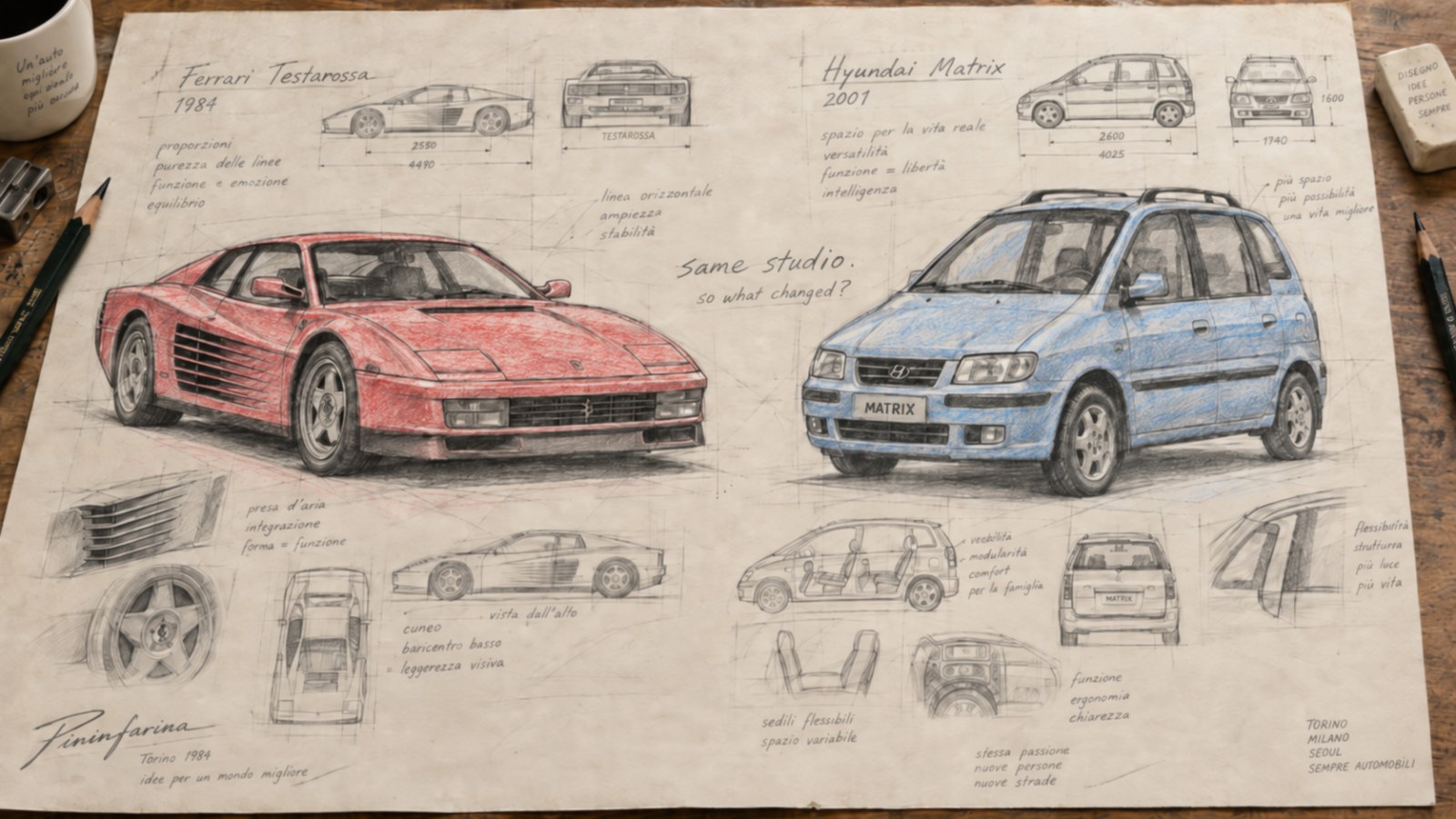
Why can the same studio design one of the most beautiful cars in the world and one of the ugliest?
How clients get the work they deserve
Pininfarina designed some of the most admired cars ever made.
It also designed the Hyundai Matrix.
Pininfarina was unquestionably one of the greatest automotive design houses in the world.
Its work with Ferrari alone produced cars that became cultural icons. Ferrari describes the Testarossa as a car that “marked an era” and calls it a masterpiece of style. Pininfarina’s own history points to the Ferrari 250 GT as part of a partnership that created some of the most beautiful cars ever built. And the Cisitalia 202 became the first car to enter MoMA’s permanent collection.
Then there is the Hyundai Matrix.
Also designed by Pininfarina.
The Matrix was launched in Europe in the early 2000s as a compact, practical family MPV. It was short enough for the city, spacious inside, relatively affordable and aimed squarely at mainstream European families.
The brief from Hyundai was clear: a car that needed to be shorter than the Renault Scénic, cheaper, practical and distinctive. Hyundai also wanted Pininfarina’s name visibly attached to it.
The result divided opinion.
That may be putting it politely.
Top Gear later mocked the design mercilessly. The Dutch ANWB noted that its unconventional exterior may have been one of the reasons it never became a major sales success. RAC described the styling as distinctive and opinion-dividing. Caradisiac eventually ran a retrospective whose title roughly translates as:
“The beauty of ugliness: Hyundai Matrix, Pininfarina’s slip.”
And yet the Matrix was not a commercial catastrophe.
European sales data shows around 204,000 units sold between 2001 and 2010, with annual sales peaking at more than 37,000 units in 2004.
So this is not really a story about whether the Matrix was a good car.
It is a much more interesting story about how good creative work actually happens.
Same studio.
Very different outcome.
It is tempting to look at a Ferrari Testarossa and a Hyundai Matrix and conclude that Pininfarina simply had a good day with one and a bad day with the other.
That would be far too easy.
Creative work does not happen in isolation.
A designer works inside a brief. A business model. A price point. Engineering limitations. Manufacturing realities. Customer research. Internal opinions. Management preferences. Timelines. Approval processes.
And often dozens of compromises accumulated between the first sketch and the final product.
The Testarossa itself proves the point.
Ferrari had a very real engineering constraint. The radiators were moved to the rear of the car, creating a packaging problem that could easily have damaged the proportions.
Pininfarina turned that technical constraint into one of the car’s defining features: the huge side air intakes and horizontal strakes that eventually became visual shorthand for the 1980s supercar.
Constraints did not destroy the idea.
They became part of the idea.
Which raises the more uncomfortable question.
What is the client’s role in creativity?
Companies often talk about hiring the best agency, architect, designer, consultant or creative team they can afford.
Then they proceed to manage the creativity out of them.
The brief becomes an instruction sheet.
Every stakeholder adds something.
Research findings become mandatory design features.
Personal preferences become feedback.
Risk avoidance becomes the objective.
And the creative partner slowly moves from solving the problem to executing a collection of decisions that have already been made.
The opposite can be equally damaging.
Giving creatives complete freedom without a strong brief, commercial understanding or intelligent challenge is not good client behaviour either.
Great clients do two things at the same time.
They create space.
And they conduct.
They define the problem clearly enough that the creative partner understands what success means.
They bring the commercial context.
They identify the real constraints.
They challenge weak thinking.
They protect the work from unnecessary interference.
Then they allow the people they hired to do what they hired them to do.
That balance is difficult.
It is also where much of the best work comes from.
The client is part of the creative product.
This applies far beyond car design.
Advertising agencies sometimes produce extraordinary work for one client and completely forgettable work for another.
The agency has not suddenly lost its talent.
The conditions changed.
The quality of the brief changed.
The relationship changed.
The approval process changed.
The willingness to take a calculated risk changed.
And the behaviour of the client changed.
Which is why choosing the world’s best creative partner does not guarantee the world’s best creative work.
The client has a responsibility for the output too. Sometimes a significant one.
Pininfarina could design the Ferrari Testarossa.
It could also design the Hyundai Matrix.
Same design house.
Same reputation.
Very different cars.
The more useful question is:
Who designed it?
That is only half the question.
The other half is:
What conditions did we create for them to design it?
The Short Pencils take
When companies evaluate creative partners, they spend enormous amounts of time asking whether the agency or consultant is good enough.
There is another question worth asking.
Are we going to be a good enough client for them to do their best work?
That means setting ambition without prescribing the answer.
Creating constraints that sharpen thinking rather than suffocate it.
Challenging the work intelligently.
Keeping unnecessary stakeholders away from it.
And understanding when to intervene and when to leave the pencil in the designer’s hand.
Sometimes the difference between exceptional work and average work sits on the other side of the table.
Want to be a better client to the partners you already pay for?
Short Pencils works on briefs, approval processes and agency governance, the conditions that decide what the work looks like before anyone starts designing.

Habib Rihana is the founder of Short Pencils, an independent marcom advisory helping leadership teams, CMOs, founders, boards, and agencies make stronger marketing and communications decisions across the Levant and GCC.