
The Cost of Consensus
Why organisations often approve exactly the kind of work they set out to avoid.
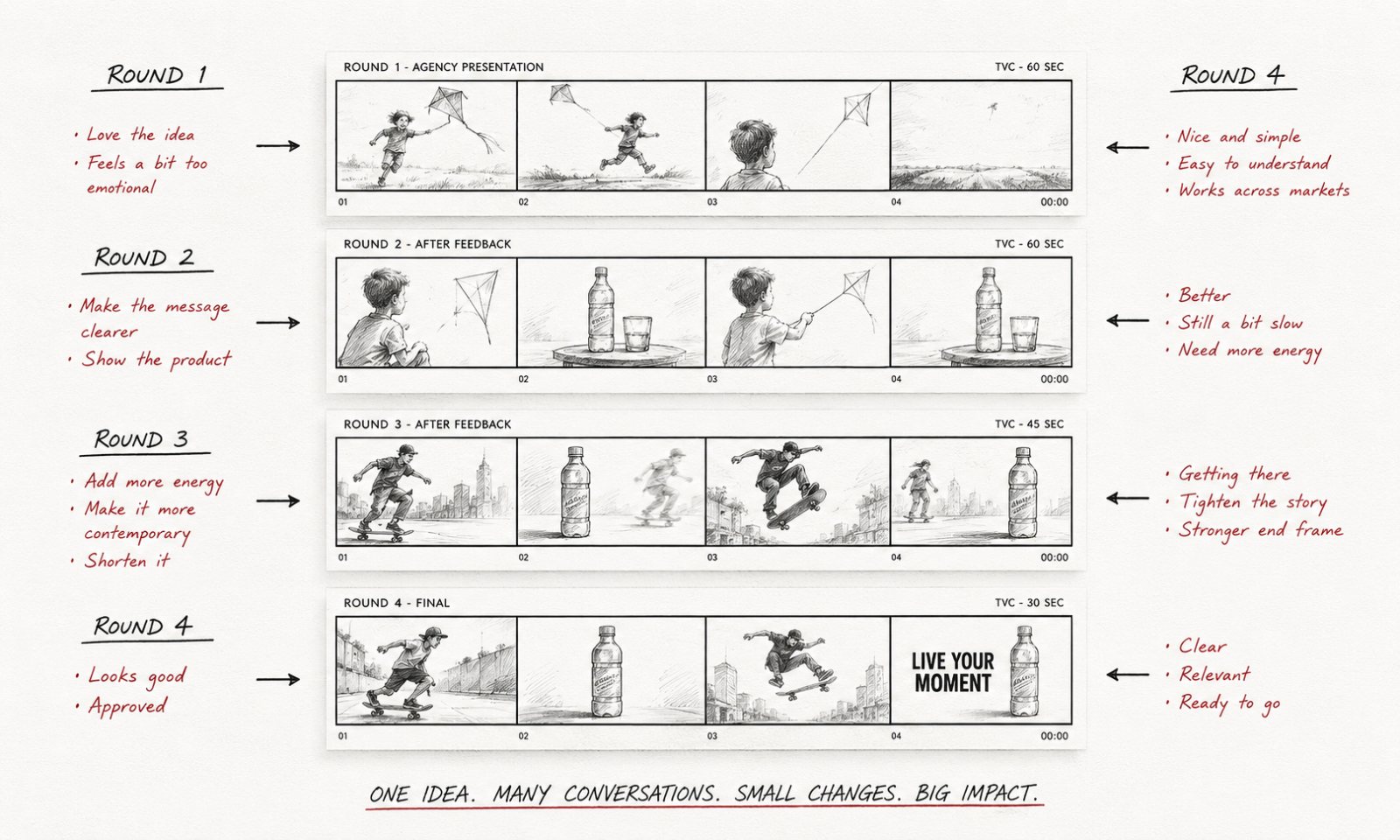
I once put two presentations next to each other on my desk. One was the agency's first recommendation and the other was the campaign that eventually went live. They barely looked like the same piece of work.
The client appointed us, a new agency, because they became frustrated with years of ordinary work. They wanted fresh thinking, stronger ideas and a clear break from what came before. Their brief was ambitious, they were resolved, and the agency responded with work that reflected exactly that.
A few months later, the client called me.
“We're getting exactly the same kind of work we were getting from the previous agency.”
It was a fair observation. I went back and reviewed some of the major projects. I compared the first creative presentations with the work that eventually reached the market.
There was no issue with the quality of the original thinking. The ideas were good, they answered the brief, and they gave the client exactly what the client asked for.
However, what I noticed was how much the work had changed along the way.
Throughout the process, nobody rejected the original thinking and no one asked the agency to start over. The work changed through discussions, comments and adjustments, one at a time, one after the other, and each one made sense at the time.
Someone wanted the message to be clearer. Someone felt the tone was too strong. Someone thought one part would be difficult to explain to senior management. Someone wanted to make sure the research team would support it.
The work changed through discussions, comments and adjustments, one at a time, one after the other, and each one made sense at the time.
None of these comments was surprising. They came from experienced people doing exactly what they were supposed to do. They were protecting the business, reducing risk and anticipating questions they believed were coming.
I've seen this happen many times over the years. While junior marketers usually react to the work in front of them with honesty, excitement and minds still untouched by fear or internal politics, senior marketers often react to the organisation around the work. They are thinking about tomorrow's meeting with the CEO, the board presentation, regional management, legal, procurement or anyone else who may eventually have a view.
The problem starts when those anticipated reactions carry more weight than the idea itself. The work changes a little in one meeting. Then it changes a little more in the next. Nobody makes a dramatic decision. Nobody says, “Let's make this ordinary.” After enough discussions, the work starts looking remarkably familiar.
By the time the campaign reaches the market, everyone has done their job. The agency has listened. Marketing has reduced risk. Leadership has challenged the thinking. Research has added confidence. Legal has protected the business.
Every one of those contributions is valid. Yet the campaign no longer reflects the ambition that existed at the beginning.
This is what I have come to think of as the cost of consensus.
Consensus is not the problem.
Every organisation needs different opinions. Ideas should be challenged. Agencies should also be challenged. I have seen agencies become attached to work that was never right for the business. I have also seen clients make ideas significantly better by asking the right questions.
The question I keep coming back to is whether every change is making the work stronger or simply making it easier to approve. Those are not always the same thing.
Whenever someone challenges my thinking, I start by assuming they may be right. Then I challenge that assumption myself. Is this improving the idea? Are we solving a strategic issue? Or are we making the work more comfortable because the original idea feels unfamiliar?
This is not only about advertising. The same thing happens in product development, innovation, customer experience, strategy and many other business decisions. Organisations usually start with genuine ambition. They want to stand out, do something different or create an advantage. Very few set out to create something ordinary.
I sometimes wonder what would happen if more clients carried out the same exercise. Take the first piece of work the agency presented and place it next to the final piece that went live. Compare them carefully. Look at every meaningful change. Then ask yourself what actually happened.
Would you conclude that the agency failed to deliver what you asked for?
Or would you recognise how many changes were made after the first presentation, how reasonable every one of them seemed at the time, and how much those changes shaped the final outcome?
Nobody deliberately removed the edge from the work. It gradually became something different through a series of sensible decisions that, taken one by one, were all easy to justify. Taken together, they quietly moved the work away from the very ambition that started the project.
Is your approval process protecting the work or diluting it?
Short Pencils supports agency selection, creative evaluation, and the governance between client and agency, with senior judgment and no stake in the outcome.

Habib Rihana is the founder of Short Pencils, an independent marcom advisory helping leadership teams, CMOs, founders, boards, and agencies make stronger marketing and communications decisions across the Levant and GCC.