

Dear Cindy, Translated
Publicis wrote WPP a very polite letter. We took the liberty of translating it.
Cindy Rose was asked during WPP’s Q3 earnings call about large pieces of business being awarded without the traditional pitch process. She referred to the “pitch-less, CEO handshake thing” and questioned whether clients were being encouraged to bypass proper due diligence. Publicis decided that required a reply.
And what a reply.
It arrived dressed as a civilised note between industry peers. The kind where everyone keeps their jacket on, uses the correct cutlery and slaps the other person with a glove.
So, in the spirit of helping the industry understand what was actually being said, here is our translation.
The handshake
Dear Cindy, 🤝
Peer to peer.
Respectful.
Ceremonial.
This is not a friendly handshake. This is the handshake before two people agree on where the duel will take place.
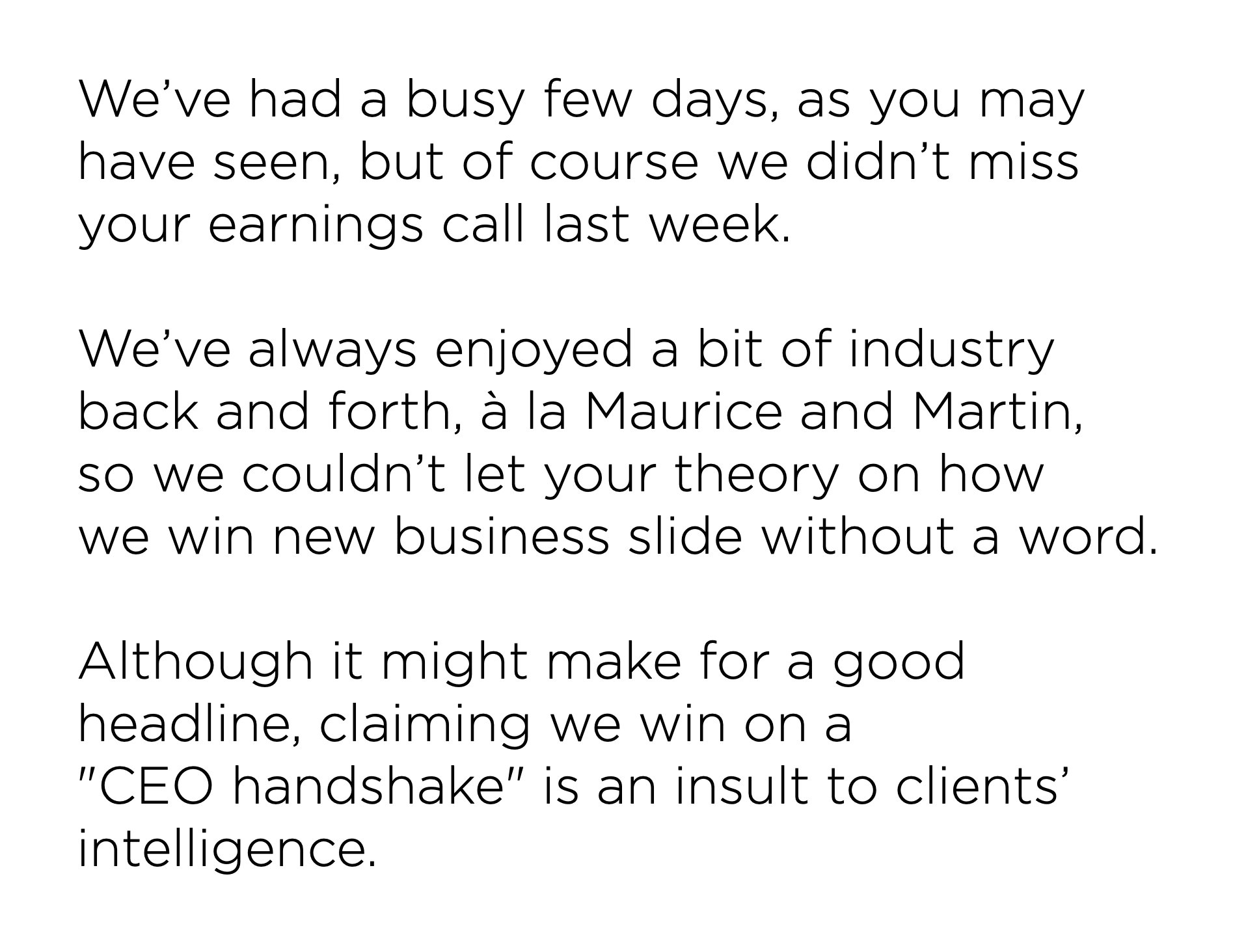
We’ve had a busy few days, as you may have seen...
Translation: We are working. We are busy. We have clients. We are winning.
“Busy” is doing a lot of work in that sentence.
...but of course we didn’t miss your earnings call last week.
Translation: We heard you.
And apparently we had enough time between winning things to listen.
We’ve always enjoyed a bit of industry back and forth, à la Maurice and Martin, so we couldn’t let your theory on how we win new business slide without a word.
Translation: We have given ourselves permission to reply.
Also, this was far too itchy to leave unscratched.
The Maurice Lévy and Martin Sorrell reference is useful. Publicis is placing the exchange inside a long agency tradition of very senior people smiling politely while trying to remove each other’s eyebrows.
Although it might make for a good headline, claiming we win on a
“CEO handshake” is an insult to
clients’ intelligence.
Translation: Flattered you think we are that influential.
But there is a second jab hidden inside the first.
Publicis takes Cindy’s comment and sends it straight back toward the client: if you believe a global company awards a huge assignment because two CEOs got along, what exactly are you saying about the people who made that decision?
Very efficient.
One punch. Two targets.
And a reminder to Cindy that she now works in a service business. The client gets a vote.
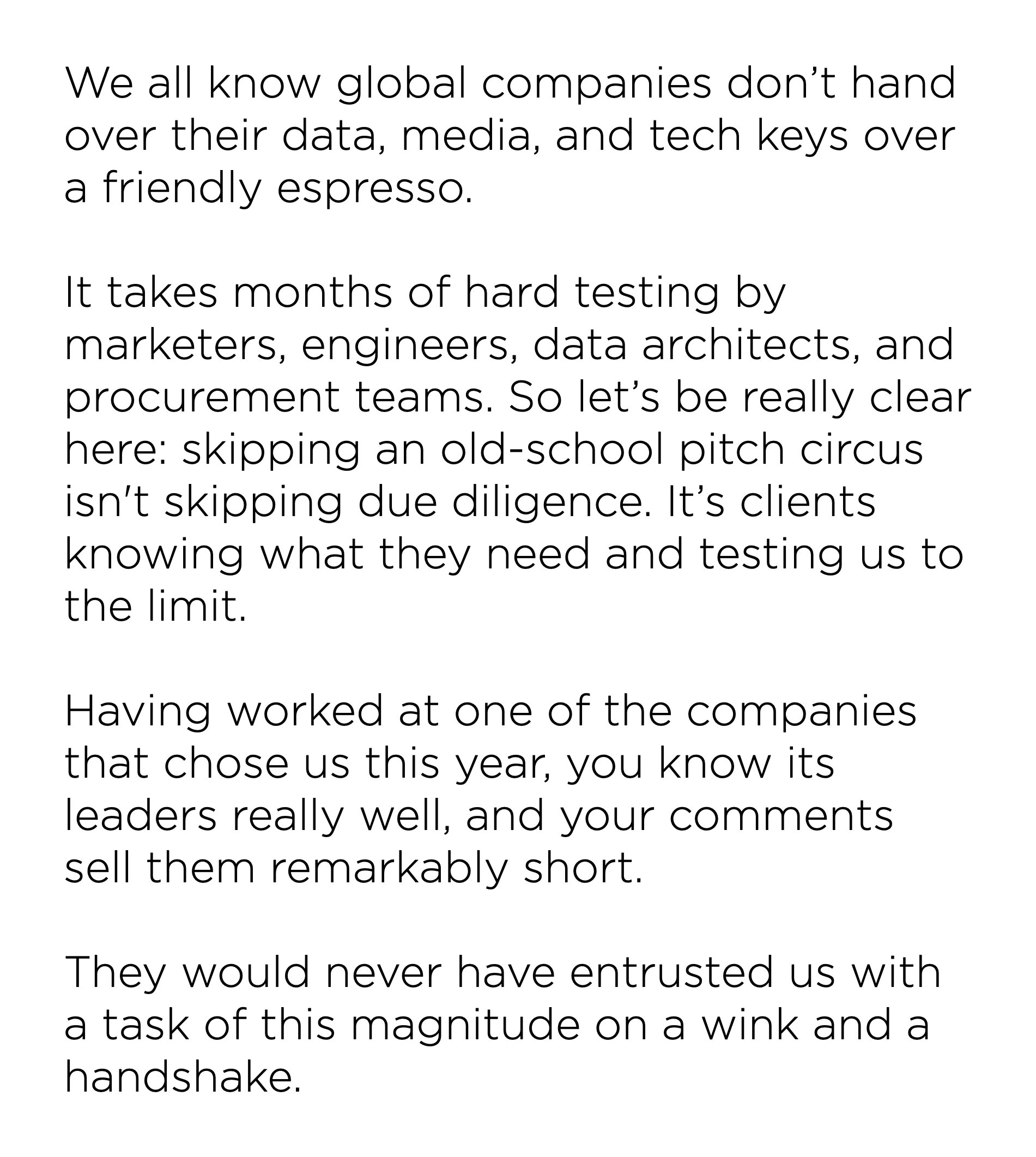
We all know global companies don’t hand over their data, media, and tech keys over a friendly espresso.
Translation: Why don’t you?
Also: this is not coffee.
These appointments can involve enormous amounts of data, technology, media investment and operational dependency. Publicis is making the scale of the decision do the arguing.
The espresso is there for decoration.
It takes months of hard testing by marketers, engineers, data architects, and procurement teams.
Translation: A lot of very serious people checked.
Marketing checked.
Engineering checked.
Data checked.
Procurement definitely checked.
Nobody woke up on Tuesday morning, liked Arthur’s jacket and transferred the account.
So let’s be really clear here: skipping an old-school pitch circus isn’t skipping due diligence. It’s clients knowing what they need and testing us to the limit.
Translation: Give the clients some credit.
This may be the most important argument in the entire letter.
Publicis is separating pitching from evaluation.
The old beauty parade is one way to assess an agency. It is not the only way.
A sophisticated client may already know which partner it wants to examine. It can then test that partner brutally, commercially, technically and operationally without putting four agencies through six weeks of theatre.
And Publicis adds the useful bit:
We passed.
Having worked at one of the companies that chose us this year, you know its leaders really well, and your comments sell them remarkably short.
Translation: You know better.
Double jab.
Publicis is reminding Cindy that she knows some of these decision-makers personally and professionally.
So now the argument gets uncomfortable.
You are not talking about some mysterious procurement committee in a company you barely know.
You know these people.
They would never have entrusted us with a task of this magnitude on a wink and a handshake.
Translation: Are you suggesting your former colleagues are idiots?
Publicis does not actually say that, obviously.
That would be rude.
So we did.
It’s as believable as saying your troops were too tired to try and win back your biggest client’s biggest market.
Translation: Give your own people some credit too.
Your teams are fighters.
They get tired. Every agency team gets tired.
But when the biggest piece of the biggest client is still sitting on the table, most agency people somehow discover another six weeks somewhere.
Publicis clearly does not buy exhaustion as the full explanation.
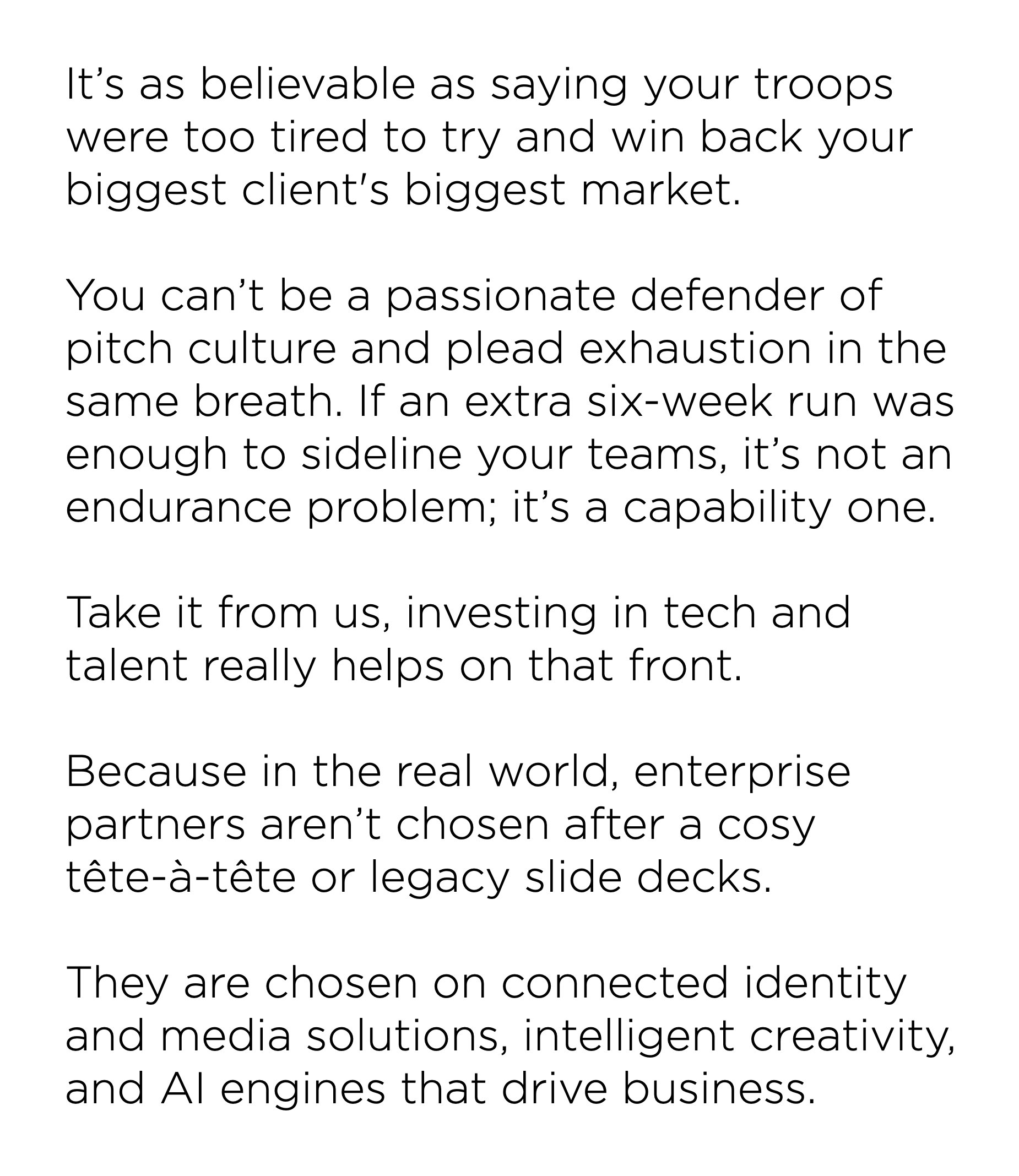
You can’t be a passionate defender of pitch culture and plead exhaustion in the same breath.
Translation: Stop playing games. Your mask is off.
You defend the pitch process when it supports the argument about proper due diligence.
Then exhaustion becomes part of the explanation for choosing not to enter one.
Publicis has spotted the contradiction and is enjoying it.
If an extra six-week run was enough to sideline your teams, it’s not an endurance problem; it’s a capability one.
Ouch.
Translation: Maybe you did not pull out because you were tired.
Maybe you pulled out because another loss would have hurt more.
A lost pitch affects morale. It affects reputation. When you are a listed company under pressure, it can also become another data point investors do not particularly enjoy.
Sometimes the safest pitch to lose is the one you never enter.
Publicis is inviting everyone to consider that possibility.
Very politely.
Take it from us, investing in tech and talent really helps on that front.
Translation: We can teach you a few things.
Possibly over coffee.
Bring a notebook.
Because in the real world, enterprise partners aren’t chosen after a cosy tête-à-tête or legacy slide decks.
Translation: Wake up.
The market moved.
Relationships still matter. Senior relationships certainly matter.
But nobody hands over a modern global marketing ecosystem because the chemistry was pleasant and the credentials deck had a nice case study from 2017.
They are chosen on connected identity and media solutions, intelligent creativity, and AI engines that drive business.
Translation: Here is the brochure.
Publicis has now moved from defence into demonstration.
Data.
Media.
Technology.
Creativity.
AI.
This is effectively the paragraph where Publicis explains why it thinks it is winning.
And, inconveniently for WPP, it has been winning a lot.
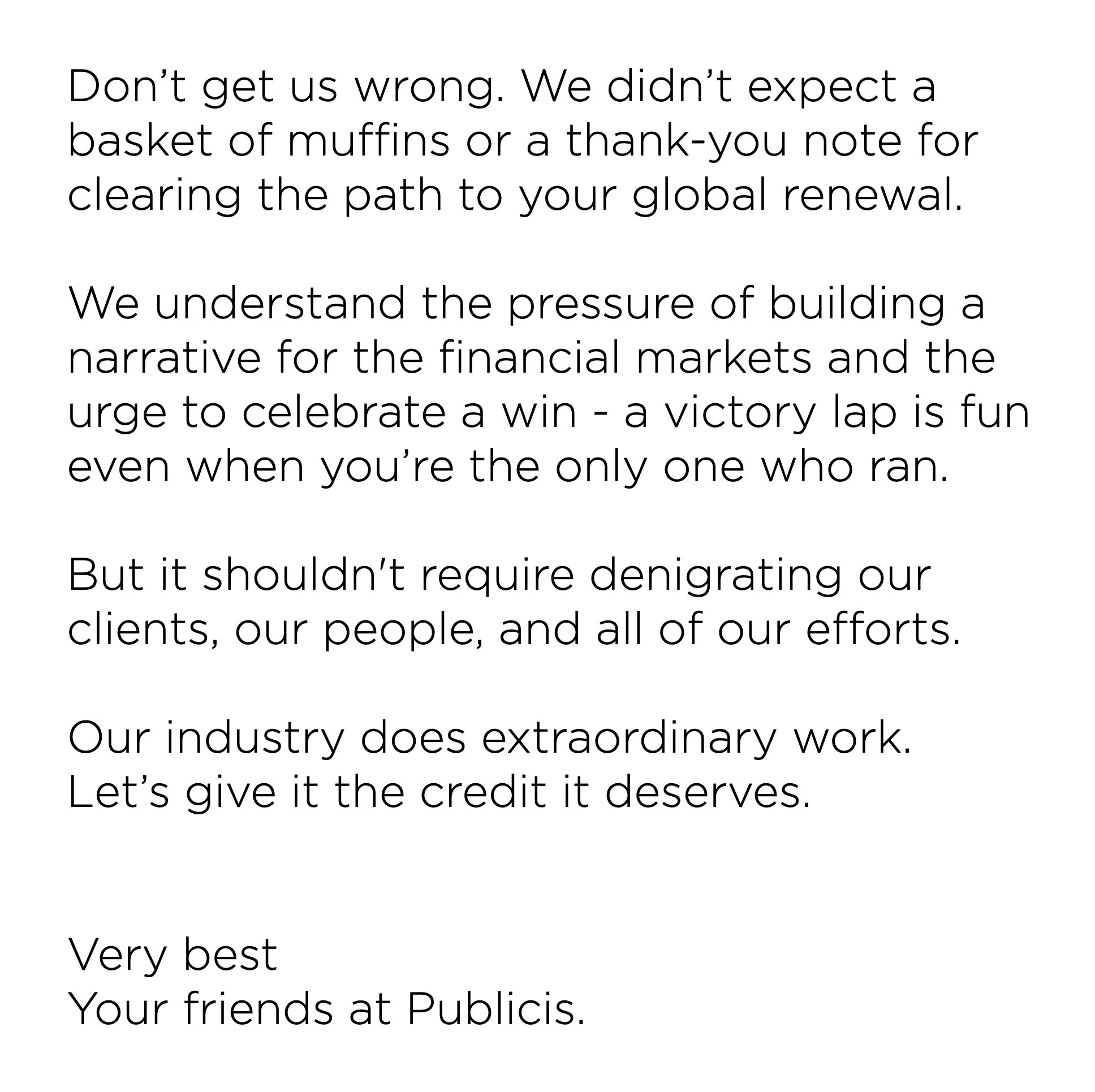
Don’t get us wrong. We didn’t expect a basket of muffins or a thank-you note for clearing the path to your global renewal.
Translation: You are welcome.
This is beautiful.
WPP retained a lot of Coca-Cola business globally. Publicis took North America.
Publicis is suggesting, with the tenderness of a brick through a window, that its North American win made WPP’s global retention story rather easier to tell.
No muffins necessary.
We understand the pressure of building a narrative for the financial markets and the urge to celebrate a win - a victory lap is fun even when you’re the only one who ran.
Translation: Enjoy it.
The share price may have a shorter memory.
Also, congratulations on winning the race after the other runner stayed home.
But it shouldn’t require denigrating our clients, our people, and all of our efforts.
No translation needed.
Publicis has had its fun and now returns to the respectable part of the argument.
Clients made serious decisions.
People did serious work.
The process deserves more respect than reducing the outcome to a handshake.
Fair enough.
Our industry does extraordinary work.
Agreed.
Let’s give it the credit it deserves.
Translation: And maybe stop explaining losses by diminishing wins.
Because eventually that damages everyone.
Very best,
Your friends at Publicis.
They are not friends.
Maybe if Cindy is nice.
But underneath all the fun, there is a much bigger story
For years, winning new business has been one of the great pain points of the holding-company agency model.
Huge teams disappear into pitch rooms.
People work nights and weekends.
Senior talent gets diverted from paying clients.
Agencies spend heavily for business they may never win.
Then everyone complains about the pitch process and does it again.
Publicis is now winning major business without the traditional pitch.
That deserves more attention than the handshake joke.
This is what happens when a decade of choices and investment starts paying back. Data, technology, talent, integration, AI and acquisitions have created a position where some clients no longer need the full beauty parade to decide.
Publicis is being tested. It is simply being tested differently.
Clients can already know which partner they want to investigate. They can test that partner deeply, put its capabilities under pressure and make the appointment without asking several agencies to perform the traditional six-week dance.
And if clients are prepared to make major appointments without forcing the agency through the old pitch circus, that is probably the strongest evidence of competitive superiority Publicis could ask for.
Cindy called it the CEO handshake thing.
I would read it another way.
The handshake is not why Publicis is winning.
The handshake is what becomes possible once you have earned the right not to pitch.
Need an independent view on an agency decision?
Short Pencils supports agency selection, pitch evaluation, and the governance between client and agency, with senior judgment and no stake in the outcome.
Habib Rihana is the founder of Short Pencils, an independent marcom advisory helping leadership teams, CMOs, founders, boards, and agencies make stronger marketing and communications decisions across the Levant and GCC.
PepsiCo moved its global media business to Publicis. The account can move. The people can move. The line around what moves with them is much harder to draw.
What to look for, what to test, and the decisions that shape the relationship before it starts.