
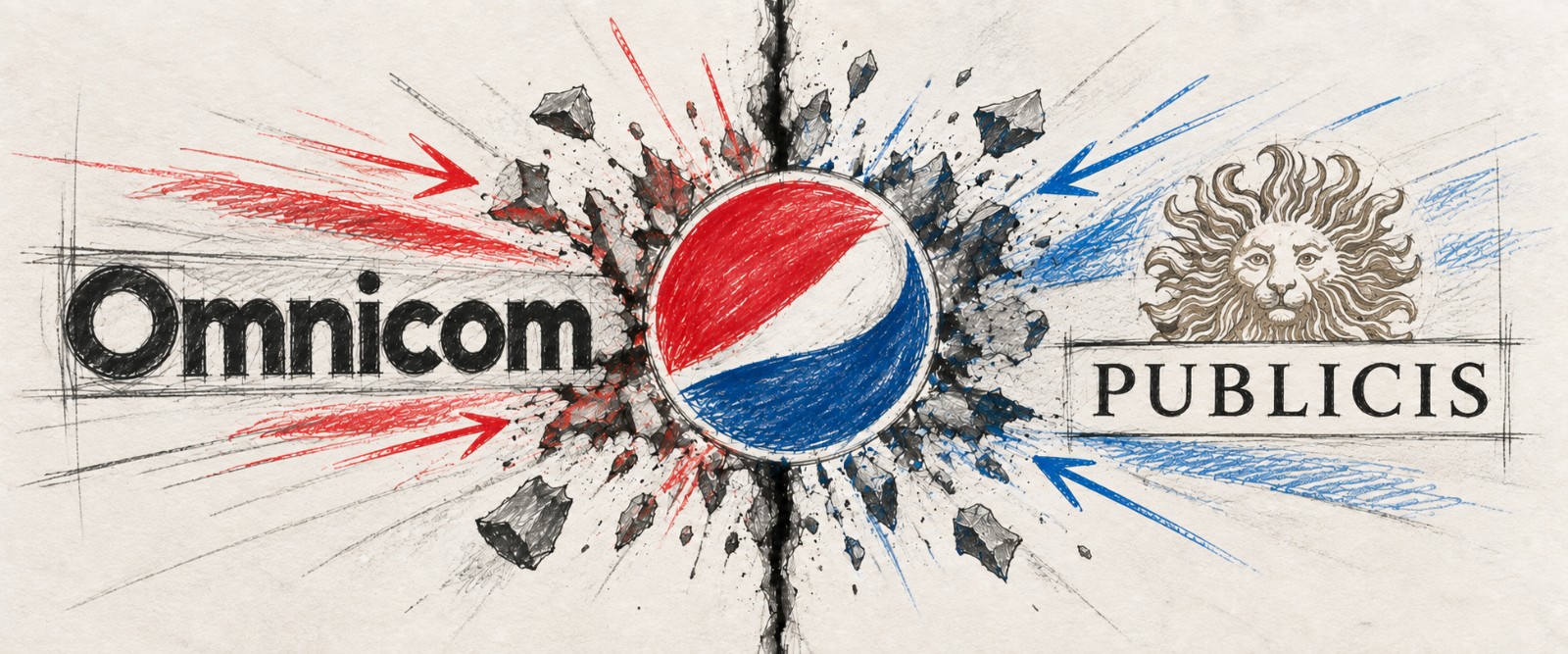
PepsiCo crosses the line to Publicis
PepsiCo has made one of the more dramatic agency moves in recent memory. After more than 25 years with Omnicom as a major global media incumbent, it consolidated its global media business with Publicis Groupe, which will build a new operating model across more than 200 markets spanning media, identity, data and technology.
Much of the discussion has focused on the scale of the move, the absence of a conventional pitch and the wider consequences for the agency market.
But another question may prove more interesting: what happens to the people who know the business?
Twenty-five years creates knowledge no handover document can fully capture. It creates judgement, relationships, instincts, assumptions and ways of working. Some of that could be enormously valuable to Publicis. Some should never cross the line. And some could quietly weaken the difference that made changing agencies worthwhile.
Let them cross
The safest transition may begin with the people who already know the business.
An account of PepsiCo’s scale cannot pause while a new agency learns how it works. Systems can be migrated and processes documented, but much of what makes a complex client relationship function lives inside people.
Someone who has spent years on PepsiCo knows where decisions really happen, what has already been tried and which apparent barriers can actually be moved. Publicis could spend years rebuilding some of that understanding, or hire people who already have it.
Hold the line
And that is precisely the problem.
The same person may also remember internal debates, commercial sensitivities, difficult negotiations and conversations that were never intended to travel beyond the relationship in which they happened.
Files can be returned. Access can be revoked. Human memory has no equivalent offboarding procedure.
Let them cross
Continuity is a commercial asset.
The business will keep moving while the agency changes. Campaigns will still go live, markets will still have deadlines and clients will still need answers. Experienced PepsiCo people could shorten the learning curve and reduce disruption.
Hold the line
Continuity can become institutional gravity.
Transitions are often shaped by reasonable accommodations: keep this report because the client expects it, retain that meeting because everyone knows it, structure the team this way because that is how PepsiCo has historically operated.
None is dangerous on its own. Together, they can slowly reconstruct the incumbent model inside the incoming agency.
Let them cross
Listen when someone says, “PepsiCo doesn’t work that way.”
That sentence may contain years of experience and save weeks of wasted effort. Institutional memory has value because it lets the new organisation start further ahead.
Hold the line
But challenge the same sentence.
“PepsiCo doesn’t work that way” can also become a defence of the status quo. Perhaps it did not work that way before. The more important question is whether it should now.
We may never know the exact weighting of technology, economics, operating model, relationships and leadership behind PepsiCo’s decision. But it chose change after more than two decades with an incumbent. Recreating the previous operating model inside Publicis would make little strategic sense.
Let them cross
Experience belongs partly to the person who earned it.
A strategist does not stop possessing category judgement when they change employers. Pattern recognition, relationships and lessons from difficult decisions become part of someone’s professional value.
Hold the line
But experience has provenance.
Some knowledge belongs to the client. Some may belong to the agency. Some belongs legitimately to the individual. And some sits somewhere between all three.
If an Omnicom strategist spent fifteen years solving PepsiCo problems, confidential information clearly stays protected and Omnicom’s proprietary systems remain Omnicom’s. But what about the strategist’s ability to recognise how a PepsiCo decision is likely to unfold?
At some point, information becomes experience, and experience becomes judgement. There is no perfectly clean line between them.
The same knowledge can be an asset on one side of the line and a liability on the other.
That is where the issue becomes bigger than confidentiality.
Publicis also has to protect what made Publicis worth choosing.
The people who can de-risk the transition may also bring old operating habits with them. It happens through reasonable statements: “We’ve tried that.” “The client won’t accept this.” “PepsiCo normally expects...”
Each may be true. Together, they can carry yesterday into tomorrow.
Protect the reason you won
Publicis therefore has two governance challenges. The first is familiar: protect confidential information, proprietary knowledge and the boundaries of previous relationships.
The second is harder: absorb institutional knowledge without allowing institutional gravity to dilute the new model.
Too little knowledge makes the transition unnecessarily risky. Too much deference to old ways makes the transformation unnecessarily small.
Carry. Protect. Unlearn.
Carry the knowledge that makes the transition better: category experience, client understanding, relationships, context and judgement.
Protect what has no right to travel: confidential information, privileged commercial intelligence and proprietary agency knowledge.
Unlearn what could dilute the reason for change: legacy processes, assumptions and habits that survive mainly because they are familiar.
There is one final irony. Agencies have long used confidentiality obligations, non-solicitation provisions, garden leave and, where enforceable, non-compete or client restrictions because they recognise that commercial value sits inside people.
But in an account move like this, the client moves first.
An employee may then leave the incumbent agency to continue working on the same client at the incoming agency. The client may value that continuity. The new agency may seek it. The employee may reasonably see years of client experience as part of their professional value.
Yet the incumbent can still lose the revenue, some of the talent, and part of the institutional capability built around that relationship. The contract may have worked exactly as written while failing to preserve some of the economic value the agency believed it was protecting.
Which brings us back to the line.
On paper it looks simple: Omnicom Publicis.
In reality, the harder line runs through people: what they know, what they are allowed to use, and what they may need to leave behind.
Let them cross. Hold the line. And protect what made crossing it worthwhile.
Agency relationships rarely change cleanly.
Short Pencils advises clients and agencies on agency selection, transitions, governance, operating models and the conditions that allow a new relationship to perform differently from the one it replaced.

Habib Rihana is the founder of Short Pencils, an independent marcom advisory helping leadership teams, CMOs, founders, boards, and agencies make stronger marketing and communications decisions across the Levant and GCC.